

You already know what your fee levels should look like. You’ve known it since the last time you ran your numbers, and the email announcing the fee increase to existing client has been “almost ready” since, well, a while ago.
This isn’t a math problem. If it were, the spreadsheet would have solved it.
When I first started my tax practice, I set my fees artificially low because I just needed income coming in, and I assumed that the low fees would drive more business. But shortly after I started ratcheting up my pricing, and I noticed no drop in conversion rates. People with a tax problem that were willing to pay for professional assistance were willing pay, period. As I increased and increased those fees, I noticed very little price elasticity.
Here’s what it looks like in a practice.
The massage therapist still at $85 an hour, same rate since 2019, who doesn’t want to “price out the regulars.” The acupuncturist whose sliding scale started with three people who truly needed it and now covers anyone who asks. The coach who answers every tight month by adding sessions instead of raising the fee, and is now fully booked and somehow still broke.
None of them is missing information. Each one is running a money script.
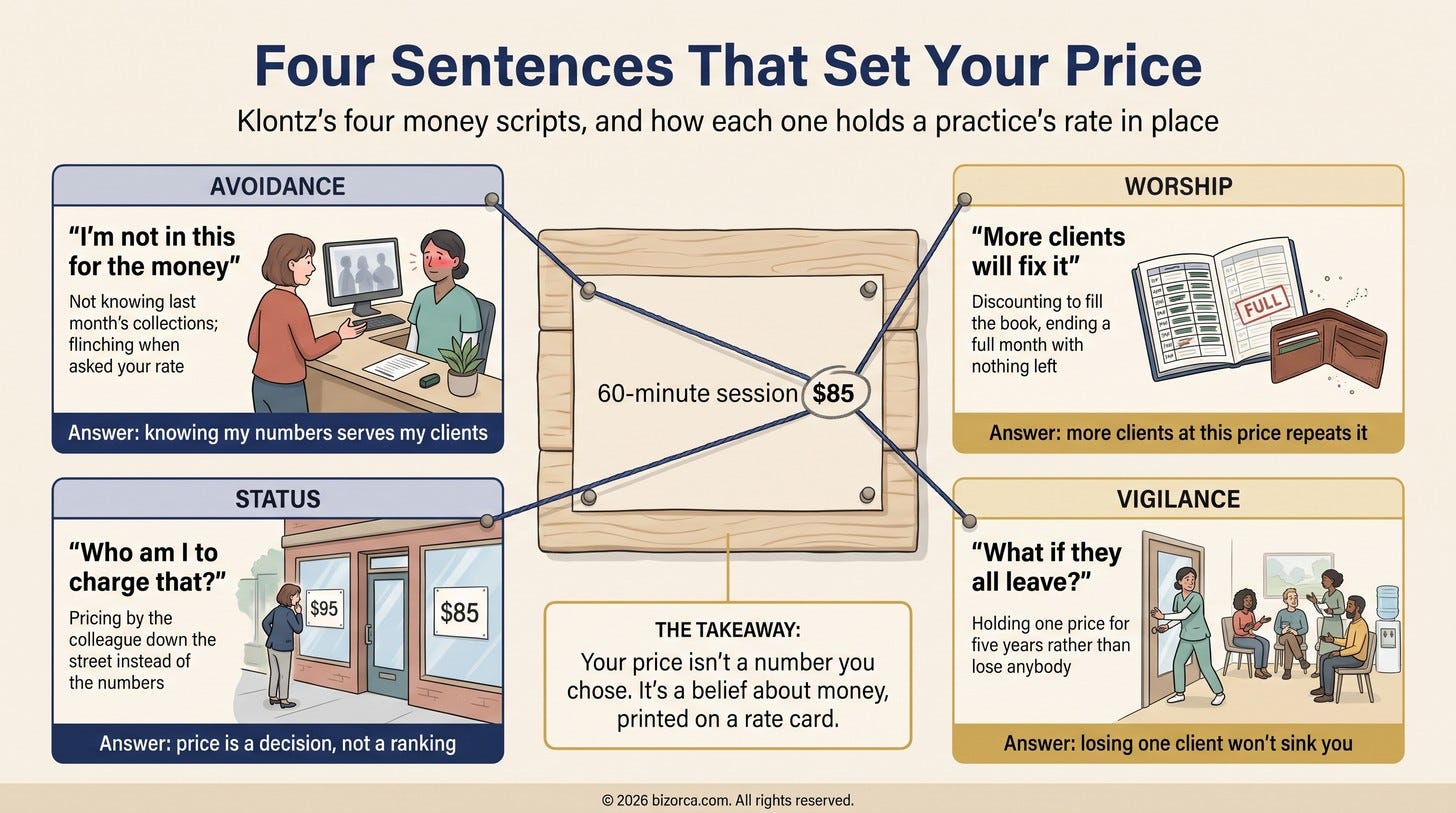
Your price often isn’t really a number you chose. It’s a belief about money, printed on a rate card.
Brad Klontz, a financial psychologist, calls these beliefs money scripts. They’re picked up mostly in childhood, rarely examined, and partly true, which is exactly why they stick. His research sorted them into four families. Here’s what each one sounds like at your front desk.
Money avoidance says “I’m not in this for the money.” Money is a little dirty, and caring about it means caring less about your clients. In Klontz’s research, avoidance went with lower income and lower net worth, and mental health professionals were more likely to hold such scripts in their heads it than financial advisors were. Does a little bit of anxiety come up when somebody asks how much you charge? That’s the script running.
Money worship says “more clients will fix it.” The answer to every money problem is more: more volume, the next certification, one more package sold. In a practice it looks like discounting to fill the book and ending a fully scheduled month with nothing left over.
Money status says “who am I to charge that?” Your price becomes a ranking of your own worth. You can’t go above the colleague down the street who’s been at it longer, or you hold a premium rate with nothing behind it, because a lower one would say something about you.
Money vigilance says “what if they all leave?” It’s the careful, saving script, and the only one Klontz ties to better financial outcomes. In pricing it tips into fear. One lost client feels like a catastrophe, so you’ll hold a price for five years rather than lose anybody.
Every one of them is partly right, which is why you’ve never argued with the sentence. You’ve just obeyed it.
Let’s start with one number: years since your last price increase.
Write it down. Then open the BLS CPI Inflation Calculator (bls.gov/data/inflation_calculator.htm), enter your current price and the year you set it, and read what that price is worth today. The gap between the two is the discount you’ve been handing every client, unannounced, every year since. Under a year since your last raise, you’re fine. Two or more, and your price has been falling behind from inflation.
You can download the two-page exercise referenced in this post as a PDF below.

In the exercise, you’ll find twelve statements to score for yourself. Sore these twelve statements from 1 (not true at all) to 5 (completely true). Don’t deliberate. The first number that shows up is the honest one.
After completing the assessment, add up the totals, and also circle your single highest scoring section. Scoring:
12 to 27: the scripts aren’t setting your price. If you haven’t raised it, the holdup is logistics, so skip straight to step 4.
28 to 43: one or two scripts are in the room. Your highest section is the voice that will talk you out of sending the email.
44 to 60: the scripts are setting your price. Run every step below, in order, and don’t skip the first three.
And if any single section adds up to 12 or more, that script is your project this week no matter what the total says.
Call this the script swap. You won’t win an argument with a belief you’ve held since you were nine, so don’t try. Write it down, give it its due, and let a procedure make the decision instead.
1. Write the sentence. Your highest section, in your own words: the exact thing the voice says when you think about raising your price. “They’ll think I’m greedy.” “I’ll lose the Tuesday regulars.” Write it the way it actually sounds.
2. Write what’s true about it. One line. You’re not arguing with it. It’s partly right, and saying so takes the air out of it.
3. Write the business answer. One sentence about behavior, not feelings.
- Avoidance: “Knowing my numbers is how I keep serving the people I care about.”
- Worship: “More clients at this price is more of the same problem.”
- Status: “My price is a business decision, not a ranking of me.”
- Vigilance: “I can lose one client and be fine. I can’t keep this price and be fine.”
4. Set the number without deciding it. You can create a baseline based on an analysis of your operating expenses and desired net income. Use the inflation-adjusted price from your baseline, rounded up to the next $5. That’s the new price. You’re not allowed to negotiate with it during this step.
5. Pick who and when, using these defaults. New clients pay the new price the day you send the notice. Existing clients get 60 days’ notice, never less than 30.
6. Write the notice now, from this:
“Starting [date], my rate for [service] will be $[new price]. Your current rate holds for every session booked before then. Thank you for trusting me with your [care / work / business]. I’m grateful to keep doing it. — [your name]”
No apology. No paragraph about rising costs. No “if this is a hardship, let me know.” If you want a hardship option, decide it privately and offer it one person at a time.
7. Schedule the send before you close this tab. Put the date on your calendar this week and tell one person what it is: a colleague, your partner, or me in the comments.
8. When the script talks, read your answer. Tape the step 3 sentence wherever you’ll see it the morning you hit send.
Go!
Twelve statements, one number, and an email you’ve already half written. This is a forty-minute job wearing a five-year disguise.
The Price Script Score is in the download: the twelve items, the scoring, and a one-page “price, decided” sheet with the notice template, built to fill in with a pen.