

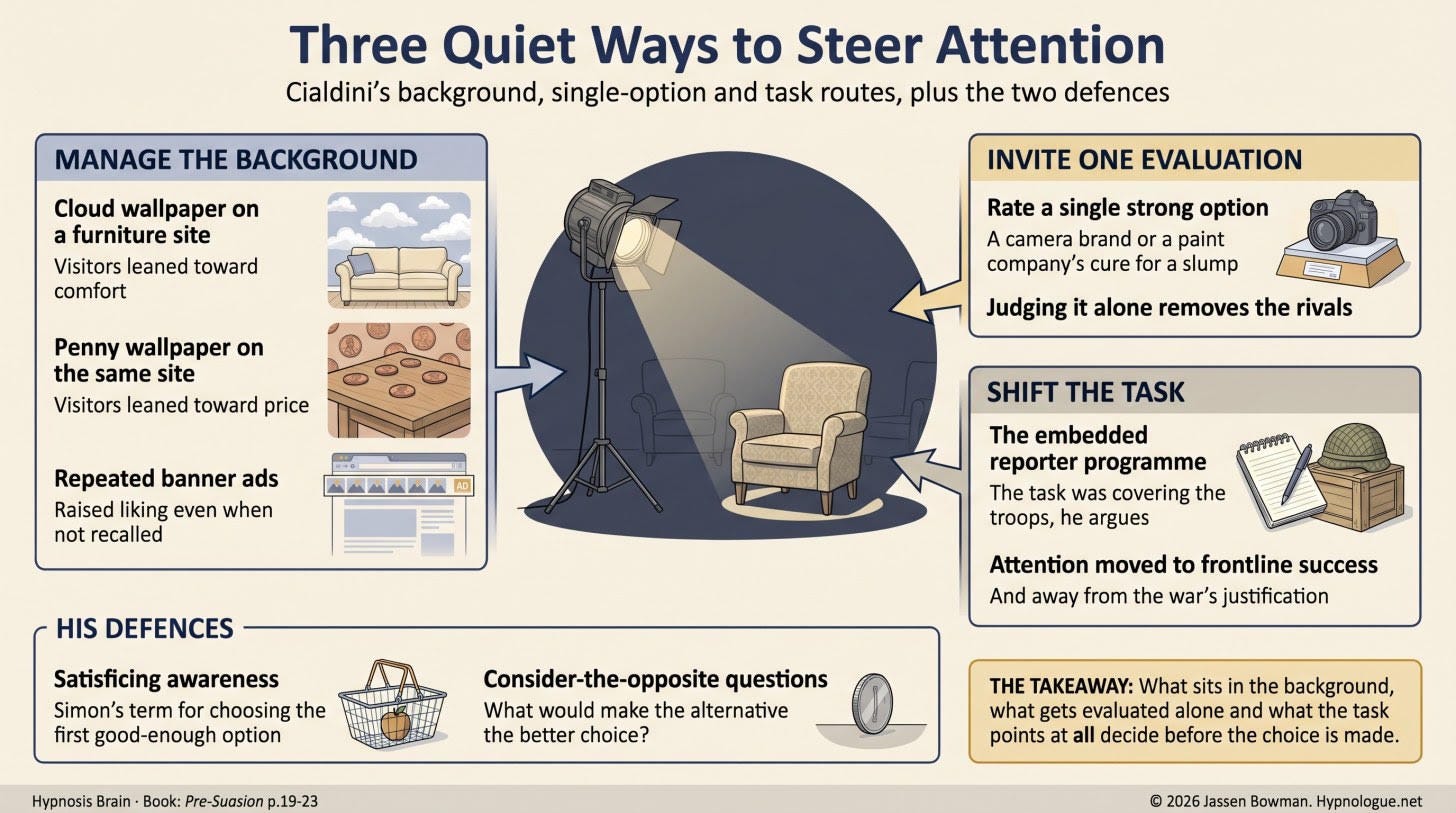
Robert Cialdini, in Pre-Suasion, argues that what people decide depends heavily on where their attention was pointed just beforehand, and he lays out three subtle ways to channel that attention without anyone noticing.
The first is managing the background. A furniture website showed some visitors wallpaper of fluffy clouds and others wallpaper of pennies. The clouds moved visitors toward comfort; the pennies moved them toward price. In the same vein, repeated banner ads raised people’s liking for a product even when they couldn’t recall seeing them. The background never asks for attention, which is exactly why it works.
The second is inviting a favourable evaluation of one option. Ask people to evaluate a single strong option, whether a camera brand or a paint company’s cure for a sales slump, and it tends to win. Evaluating it alone quietly removes the rivals from view.
The third is shifting the task. Cialdini’s example is the embedded reporter programme, which set journalists the task of covering the troops. He argues that it pulled attention toward frontline success and away from the question of the war’s justification. Change what someone is asked to do and you change what they look at.
For a financial coach these show up everywhere, on both sides. A client “just looking” at one car, one house or one fund has already had their rivals removed. A sales page that sets the task as “pick a plan” has skipped “do I need any plan?” Cialdini’s defences are worth teaching: satisficing awareness, Herbert Simon’s term for choosing the first good-enough option, so you notice when you’ve stopped looking, and consider-the-opposite questions.
This week, when a client brings you a single option to approve, ask one consider-the-opposite question before you evaluate it: what would make the alternative the better choice?