

Imagine, if you will, that you have a sick cat. I effectively have seven cats now, so I don’t have to imagine this. In fact, here’s the obligatory Internet cat pic. This is Mushroom in her tiny house:

So, sick kitty. You hop online and start looking for a vet to take your cat to. In my rural area, I only have three choices of vet clinic to go to.
Imagine that each of the three vet clinic websites list what they do, and you see the following for each vet clinic:
Example 1: “Our clinic offers comprehensive feline and canine care, including wellness exams, vaccinations, emergency surgery, oil changes, tire rotation, furnace filter replacement, minor drywall repair, pet nutrition counseling, electrical panel updates, dental cleanings, and seasonal yard debris removal.”
Result: You’re now wondering whether they treat cats—or cars.
Example 2: “Services include cat and dog diagnostics, spay and neuter surgery, ultrasound imaging, carpet cleaning, HVAC tune-ups, bookkeeping for small businesses, dental scaling, power washing, and light plumbing repairs.”
Result: The cat is still sick, but your driveway is clean?
Example 3: “We provide preventive, diagnostic, and urgent veterinary care for cats and dogs, including exams, lab work, vaccinations, dental care, and treatment for illness or injury.”
Result: Appointment scheduled. Cat cared for. Stress reduced.
In the moment, what you want is your cat cared for, and you want to feel that the place you take her is competent and will take care of your cat. The furnace is a problem for next week.
Most business communication problems aren’t this obvious. They’re far more subtle most of the time. There are excessive, extraneous, unnecessary words, like this sentence. There are unrelated options, extra explanations, maybe a sense of rambling or squirrel moments. Photos of cats where you expected an infographic. You get the idea.
Cluttered communication doesn’t just confuse clients, it creates invisible costs for you.
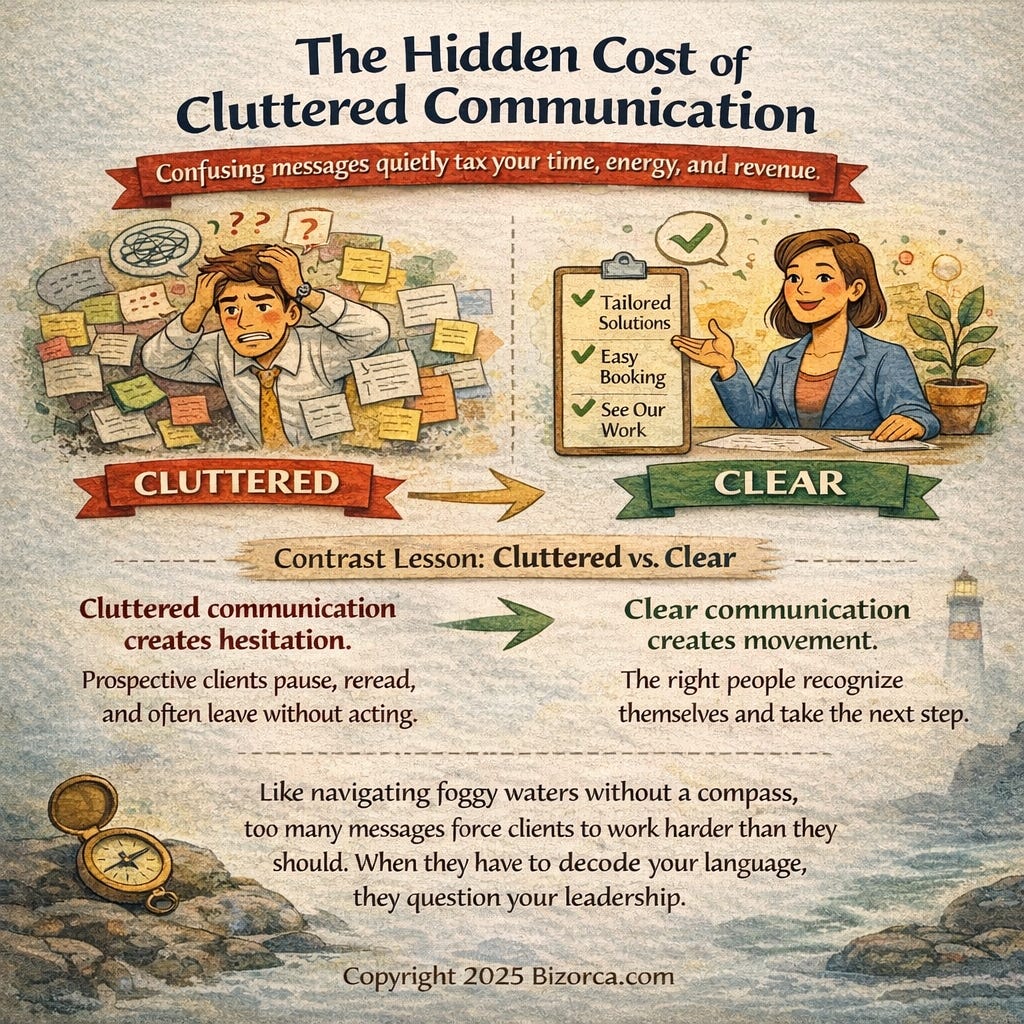
Contrast Lesson: Clear vs. Cluttered
Cluttered communication creates hesitation. Prospective clients pause, reread, and often leave without acting.
Clear communication creates movement. The right people recognize themselves and take the next step.
Like navigating foggy waters without a compass, too many messages force clients to work harder than they should. When they have to decode your language, they question your leadership, competence, and capabilities.
Three practical places to de-clutter this week:
Your offer description: Can it be understood in one sentence?
Your calls to action: Is there one next step, or several competing ones?
Your language: Are you explaining to impress, or to be understood?
Cluttered vs. Clear — one-sentence examples:
Cluttered: “I offer a range of holistic, integrative, personalized modalities designed to support transformation across mind, body, and spirit.”
Clear: “I help people calm their nervous system so they can think and function more clearly.”Cluttered: “Sessions may include a combination of practices depending on your needs and availability.”
Clear: “Each session follows a simple, repeatable process you can rely on.”Cluttered CTA: “Reach out via the form below or DM me on Instagram to explore whether working together might be a good fit.”
Clear CTA: “Book a 30-minute clarity call.”
Clear communication is a form of care. It respects attention, preserves energy, and signals confidence.
Confusion is expensive. Clarity compounds.
If this resonates, you’re invited to subscribe to Bizorca Press for calm, practical systems, or join the Bizorca Pod to simplify together, at a pace that feels steady.
Thank you for sharing this. I can’t wait to learn more from you. I definitely need to declutter my business—and my life 😅