

Every April, around the 10th, you make a promise to yourself: Next year, you’re charging more.
You make that promise at 11pm with a shoebox of client receipts open on your desk. In the moment, you really do mean it. But by November the promise has quietly expired, so the engagement letters go out at last year’s number, and the whole thing repeats.
I broke that cycle in my tax resolution practice with something I called the personality surcharge. After every consultation, before I quoted a fee, I quietly added a surcharge for how difficult the client was going to be to work with. I colloquially referred to this as my “pain-in-the-ass fee”. The client who argued with every IRS letter paid more than the one who didn’t. At the top of the scale, the number was really a polite way of saying I’d rather not take the case. It never showed up as a line item. It just lived inside the fee.
It ran the other way exactly once. A client walked in with every document I needed, already in order, and I cut the fee and told them why.
That surcharge worked because I’d decided ahead of time that hassle has a price. Most tax pros never decide. So the hassle client pays what the tidy client pays, and the difference comes out of your evenings.
Last week was about why a price increase stalls. This week, it’s time to actually do it.
Here’s what last season looked like for many tax pros (maybe YOU don’t need this message, and for that, I applaud thee!).
Let’s see what the client has: Three K-1s, a rental property, numerous crypto transactions. You billed at the same fee as the W-2 couple with a mortgage.
Or consider the client who dropped off everything on April 12th, then paid what the February client paid. The corrected 1099-B that arrived in March and turned a finished return into an amended 1040, and you did the 1040-X for free.
Or how about the the “shoebox client” that you don’t charge extra for the bookkeeping. You know the one.
Every one of those was a pricing decision. You just made it by not making it.
Your fee for next season isn’t set in January. It’s set by whatever you don’t do in November.
January is too late. By then the organizers are out, the engagement letters are signed, and you’re not about to reprice a client in the middle of tax season. The only quiet window a tax practice gets is right now, and it closes in about five weeks.
Start with one number: Your fee structure from last April.
Pull the ten returns from last season that hurt the most. The ones you dreaded, redid, or chased documents for. For each one, divide the fee you collected by the hours you actually spent, including the phone calls, the missing-form emails, and the second look after the late K-1 comes in. Average the ten.
That’s your April number, the hourly rate your worst work really paid. If it’s within 20% of your standard rate, your pricing is mostly honest and the problem is logistics. If it’s half your standard rate or less, your fee schedule has been subsidizing your most difficult clients, and your easiest ones are paying for it.
Now answer these without looking anything up.
1. Can you state your base fee for an individual return, out loud, right now?
2. Have you raised that base fee in the last two seasons?
3. Is your fee schedule written in your engagement letter, or does it live in your head?
4. Do you charge more when documents arrive in the last two weeks?
5. Do you charge for an amended return caused by a client’s late or corrected form?
6. When a client asks “how much?”, do you say a number before you say “it depends”?
7. Have you repriced or let go of a client for being difficult in the last three years?
If you said no to three or more of these, you have your project for November.
That last one deserves a second look. If you’ve never lost a client over price or hassle, you aren’t charging for either.
I’m going to repeat that: If you’ve never had a client push back on your fees, you aren’t charging enough.
Call this the November fee reset. It takes an afternoon, and it’s built so you don’t have to win an argument with yourself about any of it. The procedure makes the decisions.
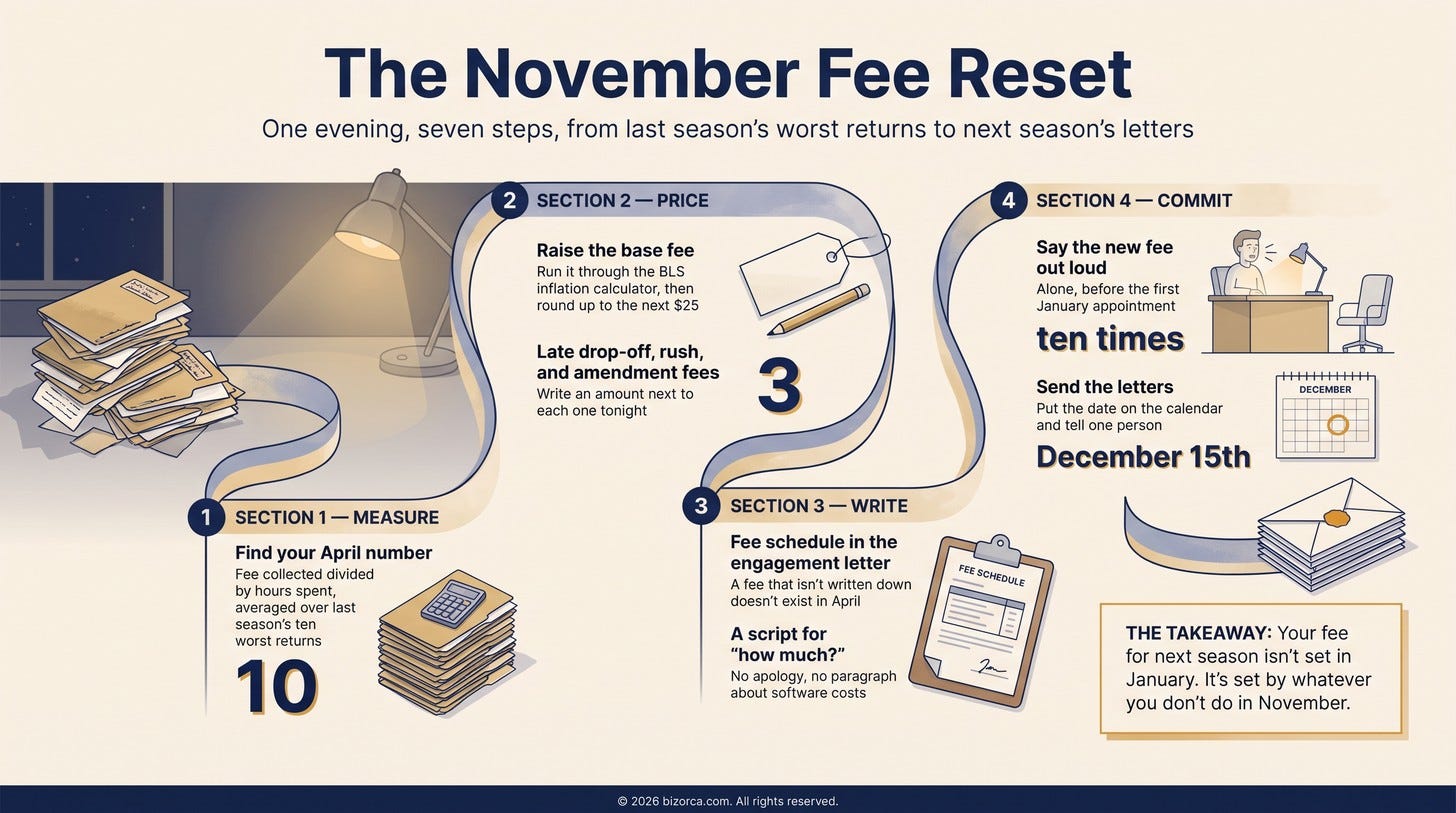
1. Set your floor. Pick the lowest hourly rate you’re willing to work for next season. Any return type whose April number sits below it gets repriced. No exceptions for regulars, and especially none for the regulars you dread.
2. Raise the base. Take your current base fee, run it and the year you set it through the BLS CPI Inflation Calculator (bls.gov/data/inflation_calculator.htm), and round the result up to the next $25. That’s the new base. Don’t try to rationalize it away.
3. Add three hassle fees. Write an amount next to each one today:
- A late drop-off fee, for documents that arrive after a date you choose.
- A rush fee, for anything a client needs faster than your normal turnaround.
- An amendment fee, for amended returns caused by a client’s late or corrected documents.
These aren’t punishments. They’re the price of the evenings those returns used to steal for free. A client who brings a tidy folder in February never pays any of them, and that’s the point.
4. Put it in writing. The full fee schedule goes into the engagement letter and the organizer cover sheet. A fee that isn’t written down doesn’t exist in April, because in April you won’t have the energy to invent it on the spot.
5. Use the script. When a client asks, say it like this:
“This season, your return starts at $[base fee]. If your documents come in after [date], there’s a $[late fee] late fee. Everything’s spelled out in your engagement letter.”
No apology. No paragraph about software costs. No “but for you….”
6. Say the number out loud ten times. Before your first January appointment, say your new base fee out loud, alone, ten times. It sounds silly. It’s the step that keeps your voice from catching when a real client asks, which is where most fee increases actually die.
7. Schedule the send. Put a date on your calendar, December 15th or sooner, for the engagement letters to go out with the new schedule. Then tell one person what the date is: a colleague, your partner, or me in the comments.
One afternoon, ten returns, three hassle fees, and a script. This is a November job wearing an April disguise.
Do the April number first. Once you see what your worst returns actually paid, the rest of the decisions make themselves.
Write the hassle fees down. Write the hassle fees down. Write the hassle fees down TODAY!
The Fee Reset Score is in the download: twelve statements that score where your pricing leaks, plus a one-page fee reset sheet to fill in with a pen.

And if you’d like company for step 6, I run a free monthly Zoom called Behind the Books, for practitioners and business owners of all types. The next one is Tuesday, November 17th, 5 to 6:15 pm Pacific (8 to 9:15 Eastern), and this month’s topic is about your fee: The mental story behind the number, developing the wherewithal to charge what you’re worth, and saying it out loud until it stops catching in your throat. It’s free and it’s for any kind of practice. Get the Zoom link at financialhypnosis.com/biz.
This is the money psychology side of what I do now. If you have any sort of mental blocks around pricing or anything else in your business, join me for Behind the Books each month.