

Every dollar you spend is telling you something. Most people never stop long enough to listen.
Here’s a question that sounds simple but will rearrange your entire relationship with money: Why did you buy that? Not what you bought. Not how much it cost. Why. The answer almost always falls into one of three categories — and once you see the pattern, you can’t unsee it.
I call it the Survival/Comfort/Escape Matrix. Every single transaction in your bank account and credit cards fits into one of these three channels. Understanding which channel is pulling the most current changes everything about how you navigate your finances, and getting control over your finances involves aligning your values with how you spend.
The Three Channels
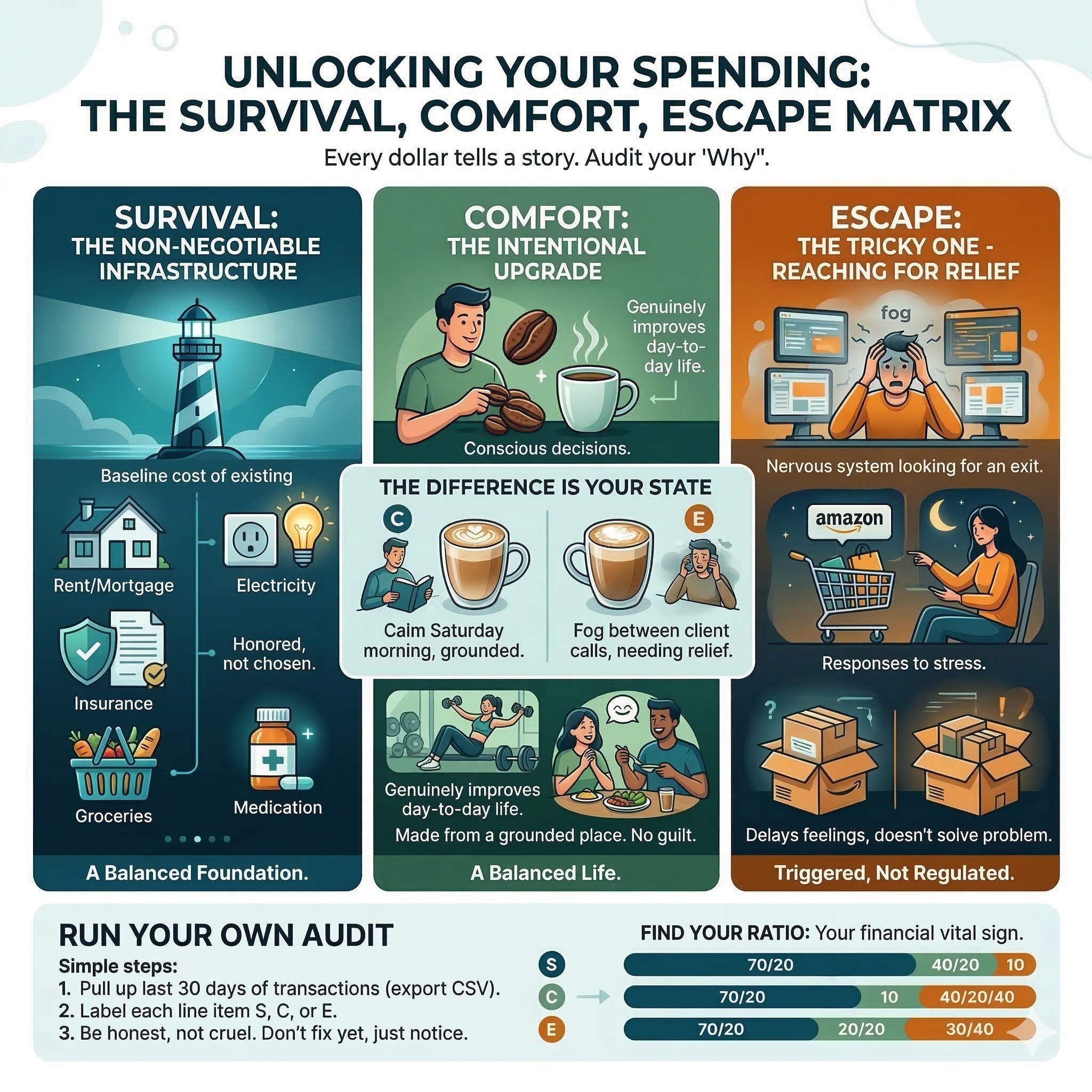
Survival is the non-negotiable infrastructure. Rent, electricity, insurance, groceries, medication. These are the costs of keeping the lights on — the lighthouse, if you will. You don’t choose them so much as you honor them. They represent the baseline cost of existing and having a functional life. In Japanese kakeibo budgeting parlance, these are your Needs (more on kakeibo in a moment).
Comfort is the intentional upgrade. The slightly nicer coffee beans. The gym membership you actually use. A meal out with someone you love. Comfort spending is conscious. You know you’re doing it, you’ve decided it’s worth it, and it genuinely improves the texture of your day-to-day life. There’s no guilt here because the decision was made from a grounded place. In relation to kakeibo budgeting, these fall into Wants and Culture.
Escape is the tricky one. Escape spending happens when your nervous system is looking for an exit. It’s the $47 Amazon order you placed at 11 PM because the day was brutal. It’s the subscription you forgot you had because you signed up during a rough week and never circled back. Escape spending doesn’t solve the problem it’s responding to. It just delays the feeling for a few hours. In kakeibo structure, I would put these under the Unexpected category.
The difference between Comfort and Escape isn’t the item. It’s the state you were in when you bought it. A $6 latte purchased on a calm Saturday morning while reading a book is Comfort. The same $6 latte purchased in a fog between back-to-back client calls because you needed *something* to feel like a human being — that’s Escape. Same drink. Completely different current.
The Scramble vs. The System
Most financial advice skips this entirely. The conventional approach treats every dollar the same: income minus expenses equals savings, and if the number is negative, you need a budget. Cut here. Trim there. Use a spreadsheet. Try harder.
That’s the scramble. It assumes you’re a calculator with legs — that the problem is math and the solution is discipline. It works for about two weeks, until a hard day hits and the escape spending kicks back in. Then comes the shame spiral, which makes the next escape purchase even more likely.
The system looks different. Instead of auditing what you spent, you audit why you spent it. You pull up last month’s transactions and sort every single line item into one of three columns: Survival, Comfort, or Escape. No judgment. Just sorting.
What you’ll find is revealing. Most people discover that their Survival costs are relatively fixed — there’s not much to cut without genuinely destabilizing their life. Their Comfort spending is usually reasonable and intentional. And their Escape spending is where the current has been quietly pulling them out to sea.
How to Run Your Own Matrix
Pull up the last 30 days of transactions. Every single one. Then go line by line and label each transaction S, C, or E. An easy way to do this is to perform a CSV export from your online banking and credit card sites, and import those CSV files into an Excel or Google Sheet.
A few ground rules:
Be honest, but don’t be cruel. This isn’t a punishment exercise. It’s a diagnostic.
If you’re not sure whether something is Comfort or Escape, ask yourself: *Was I regulated when I made this decision?* Did I feel calm, or was I reaching for relief?
Don’t try to fix anything yet. Sorting is the whole exercise. Fixing comes later, and it comes naturally once you can see the pattern.
When you’re done, add up the totals for each column. That ratio — the percentage split between Survival, Comfort, and Escape — is your financial vital sign. It tells you more about your actual relationship with money than any net worth calculation ever will.
There’s no “correct” ratio. Someone spending 70% on Survival, 20% on Comfort, and 10% on Escape is in a fundamentally different position than someone at 40/20/40, and they need fundamentally different interventions. The person drowning in Survival costs doesn’t need a budget app; they need more income or a structural change. The person hemorrhaging Escape spending doesn’t need a lecture about lattes; they need regulation.
If you’d like to use a financial health tool to keep track of this for you, head on over to Heartfelt Finance and create an account. This is a free financial mindfulness app that I’m building as part of my mission to grow financial literacy and wellness.
Your One Simple Move This Week
If you’re not ready to do the above audit for an entire month, or to start tracking all your spending in an app, do this one simple thing: Pick one day’s worth of transactions — just one day — and label each one S, C, or E. Don’t change anything. Don’t cancel any subscriptions. Don’t shame yourself for what you find. Just notice.
The ship’s rigging doesn’t get organized in a storm. It gets organized on a calm morning, with clear eyes, one rope at a time.