

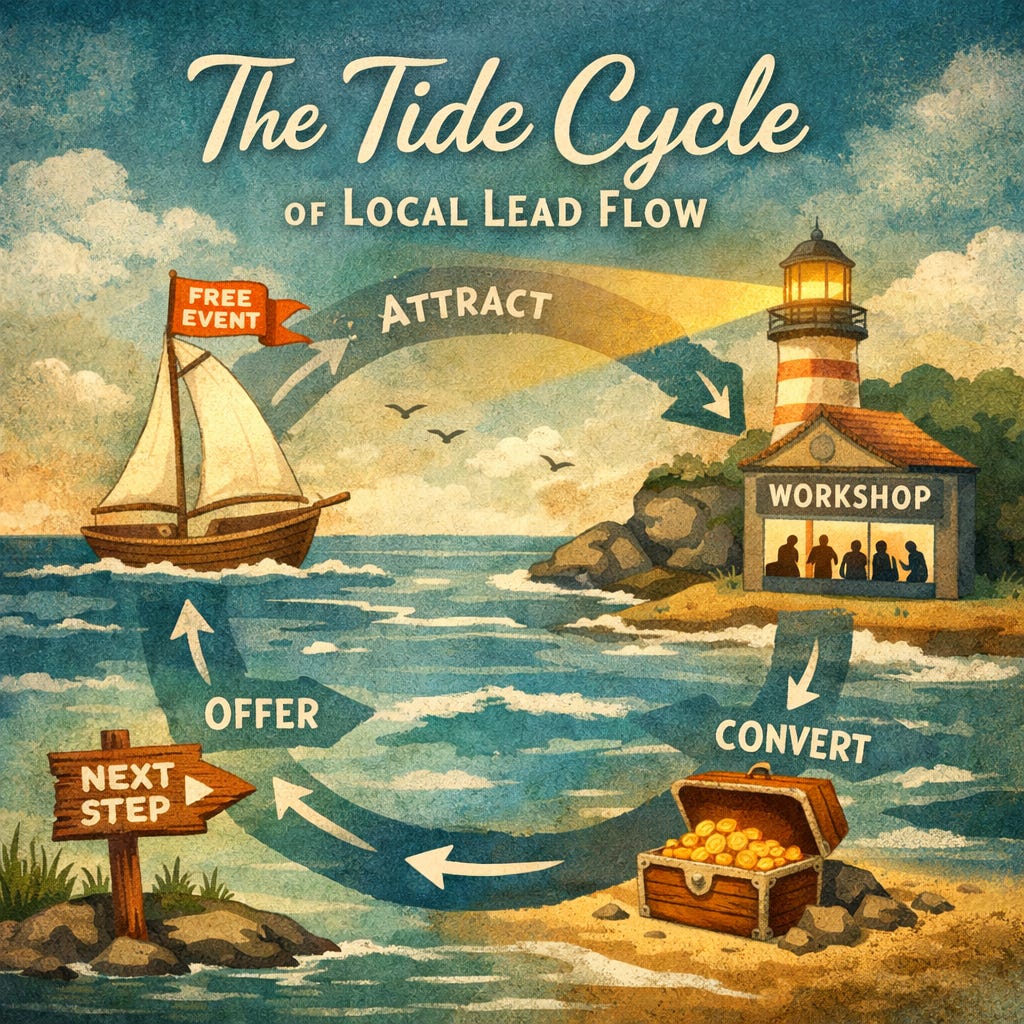
If you want a steady stream of new clients coming in to your local practice, the single best marketing strategy — even in the digital age — is to put butts in seats and educate your audience.
I have never found a simpler, more consistent growth strategy for any sort of professional practice to drive growth than by presenting small workshops to people already interested in your particular topic. Seminars and workshops are interactive, engaging, and build trust and authority faster than any other marketing tactic I’ve ever seen.
When you are the person at the front of the room, you have instant authority and credibility, which in a trust-based business, is utterly invaluable. On top of that, giving freely of your time in this way clearly demonstrates how much you care about what you do and the people you serve. Offering free workshops is an extremely tangible way of showing that you are a heart-led practitioner.
In this marketing deep dive, you’ll learn exactly how to conduct such events, attract attendees, and invite them to work with you further if there is alignment.
Three Different Companies, Same Strategy
If I had known about this strategy earlier in my business career, I firmly believe that I wouldn’t have struggled as much as I did earlier in life. But fortunately, I did find this strategy in my 30s, and it helped drive the growth of three different businesses that I owned.
When I ran my own tax firm, representing small business owners with state and IRS tax debts, one of my marketing strategies was to host live, 1-hour webinars educating people about their options for addressing the tax debt. Basically, most people aren’t aware of the government programs that are available to help them. I found attendees for these webinars by sending direct mail postcards and letters to publicly available lists of tax liens. Then, at the end of each webinar, I would make an offer to book a private consultation with me.
When I started Tax Resolution Academy, I had three core marketing methods to attract clients. What really made the business grow from a side project to a larger business was a 42-city tour of the US that I offered in 2014. In each city, I hosted a three hour live workshop that included one hour of business development education, and two hours of ethics continuing education. Since tax professionals are required to complete annual ethics education to keep their license, offering this for free was the perfect way to attract attendees, whom I invited to the event via email, collecting emails from a publicly available list of such tax professionals.
To a lesser degree, but still pivotal to early traction, the software company I started in 2015 was also fueled by events. Hosting lunch and learns for training coordinators and managing partners of Seattle area CPA firms, invited directly by phone, email, and LinkedIn direct messages, gave us validation around product-market fit and some of our earliest pilot customers.
Prominent Examples
Perhaps the most widely known application of this event marketing strategy comes from the financial services industry. Ever since the 1950s, the “free dinner seminar” has probably sold more annuities and other investment products than any other strategy.
In fact, this marketing method is so prominent for annuity sales in particular that entire marketing agencies exist that do nothing but help financial advisors to reserve private dining rooms in restaurants, send out postcards and letters to high income and high net worth individuals, and process registrations and reminders for the dinner. The prominence of this marketing strategy in the financial planning world is so prevalent that it’s basically a meme in personal finance circles.
Another prominent example of the use of this strategy comes from the network marketing (e.g., multi-level marketing or MLM) industry. Free dinners, free education nights, and free workshops are taught by the company to their representatives as a way to sell product and recruit new downline.
Within the real estate investor coaching industry, the common tactic is to use free half-day or even full day workshops to introduce concepts such as wholesaling, flipping, private lending, and other real estate strategies. A free brown bag lunch is often included. Attendees are then upsold on coaching programs that costs thousands, or even tens of thousands, of dollars (but you can save that money and check out the extensive free resources offered by my good friend James Orr at RealEstateFinancialPlanner.com instead. You’re welcome.)
These prominent examples may sound scammy or slimey to some readers, and yes, they often are. But the fact that they still exist, even in the modern Internet age, and drive billions of dollars in revenue, serve to demonstrate that the marketing strategy itself works very well.
Using this strategy for your own service business boils down to three steps: Crafting your workshop curriculum, attracting the right attendees, and then making an offer to work with you further.
Your Free Introductory Workshop
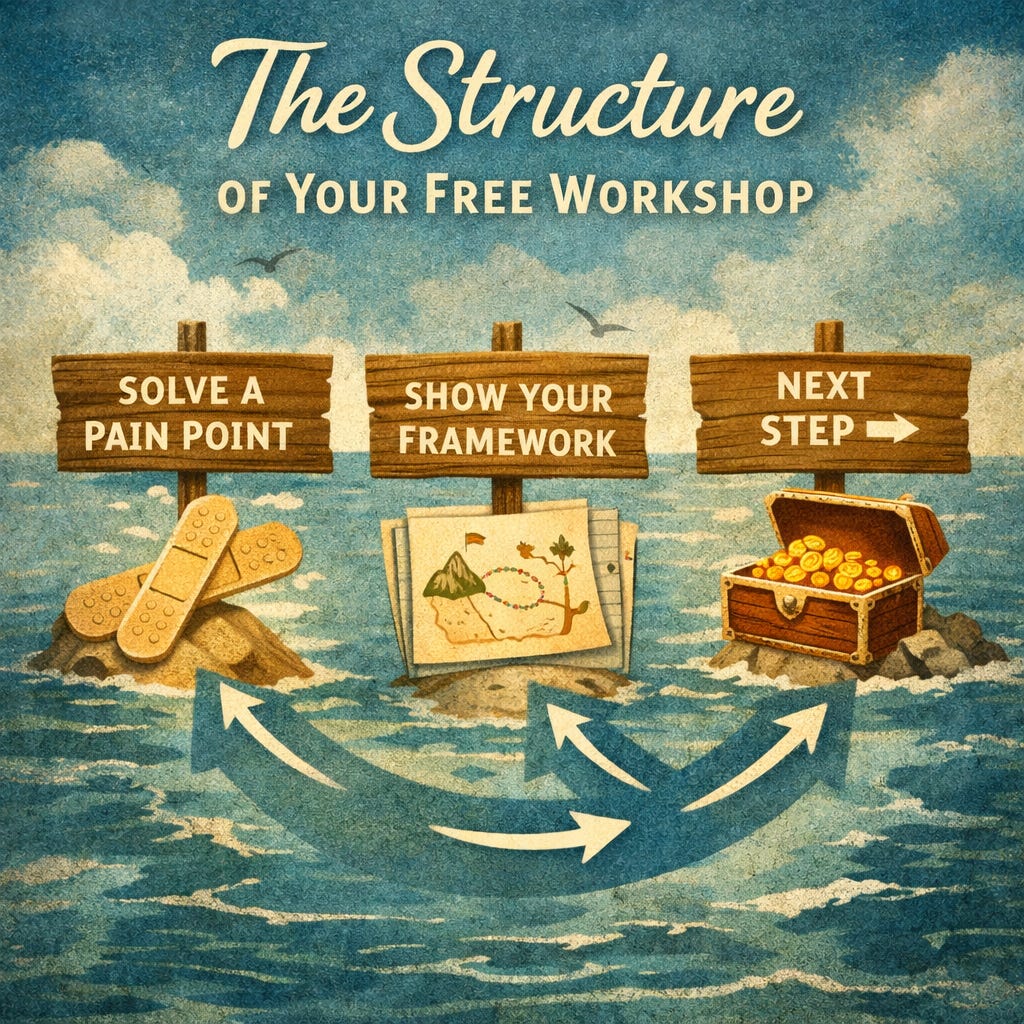
Your opening offer is a free one to two hour webinar, class, or workshop. It should be something small enough to provide solid value within that timeframe, meaning it should have substance, not fluff.
Requirements:
Solve a specific, meaningful pain point.
Reveal your larger method.
Make the next step clear for attendees.
Here are some real-world examples based on local business owners that I consult with:
A private chef could offer a free workshop on meal planning.
A therapist could offer a free workshop on setting boundaries.
A nutritionist could educate attendees about metabolic syndrome.
An accountant could walk new business owners through setting up their record keeping system.
An herbalist could demonstrate how to harvest specific herbs and compound three commonly used formulations.
A massage therapist could teach a couples workshop on providing neck and shoulder massages for your partner at home.
Brainstorm a few ideas of what you could demonstrate inside of one hour, and share it with your fellow readers in the comments section.
Filling the Room
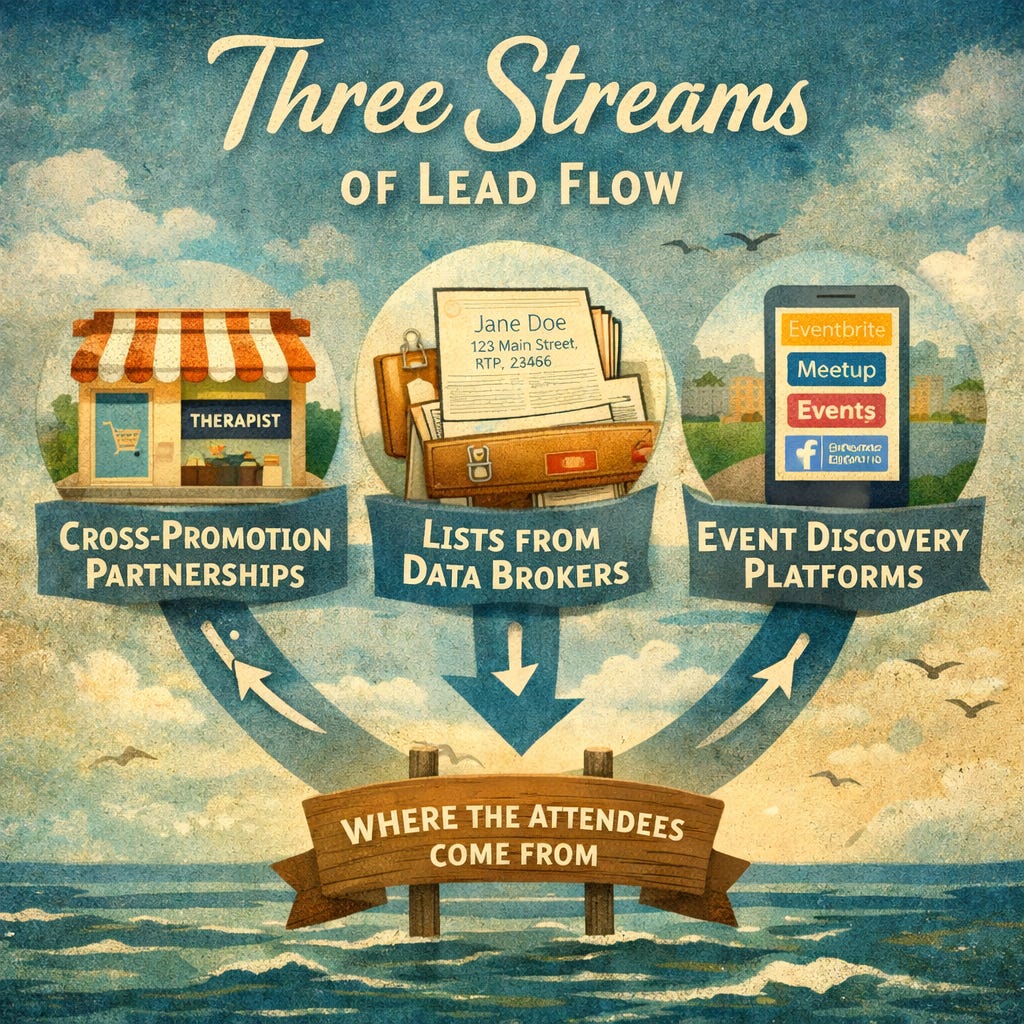
For many readers, this might be the most challenging step. But it doesn’t need to be difficult or complicated. The key is to attract the right attendees, not just any attendees. Let’s cover three distinct methods for putting butts in seats for your live workshop.
Cross-Promotion Partnerships
This one is the low-hanging fruit. Basically, you approach complimentary businesses, trade associations, training companies, and the like that already work with your ideal client. Your ideal client could be receiving education from this promotional partner, maybe they’re a customer of this other business, or are a member of a club or association related to your offering.
Here are some examples from the same professions mentioned earlier:
A private chef could partner with health food stores and kitchen gadget stores to promote the meal planning workshop to their customers (and perhaps even host the event inside that store).
A therapist could partner with other therapists, behavioral health agencies, and victim advocate services to promote the workshop to their clients.
A nutritionist could work with health food stores, herbalists, and concierge physicians to promote their workshop to clients of those businesses.
An accountant might partner with their local Chamber of Commerce, Economic Development Council, Small Business Development Center, and co-working space.
An herbalist could present a workshop to their local Master Gardener foundation, and work with nurseries and health food stores to promote the event to their customer lists.
A massage therapist could partner with relationship therapists and sexual wellness stores to offer the couples massage workshop.
In short, find the other businesses that serve the exact same type of customer that you want. Pick up the phone and call the owner, take them out to lunch, discuss how the workshop will be of benefit to their customers as a value-added service.
If you’d like help in identifying specific organizations and companies to partner with for promotion of your workshop, book a call with me.
Lists from Data Brokers
We all know that exhaustive amounts of data are collected by companies about all of us, and that data is sold and rented by companies all the time. While I personally despise the practice from a personal privacy perspective, I’ve also used it extensively as a business owner.
There are numerous data brokers out there, and for a fairly small amount of money, you can buy a list of names, addresses, emails, and phone numbers for just about any client profile.
Take the time to brainstorm the demographic profile of your ideal client, along with specific consumer actions they have likely taken.
For example, the private chef might want a list of local residents with incomes over $250,000 per year that have purchased high-end kitchen appliances. That list can be purchased or rented.
The therapist running the trauma workshop can likely obtain a list of people that have bought books on dealing with trauma, or that have indications of specific mental health conditions (yes, despite privacy laws).
The massage therapist leading the couples workshop can definitely obtain a list of couples that have purchased…ummm… “intimacy products” from online retailers.
Nearly every state, either through their Department of Revenue or Secretary of State, offers lists of new business entity formations for sale. Your local county or city may also offer a list of new business licensees for sale. The accountant offering the business record keeping workshop will want that list.
What are some of the purchase behaviors of your own ideal client?
What other products and services, related to yours, have they purchased?
Where did they purchase them?
Also consider what organizations they belong to, because you can likely buy or rent the membership list. Think about civic, political, and trade organizations they might be members of, or magazines they subscribe to. A private chef might be highly interested in obtaining the subscriber list for the local foodie magazine, an accountant might want to acquire the subscriber list of the local business publication, etc.
Event Discovery Platforms
This one is a bit more non-specific, but still of value in promoting your event.
Think Meetup.com, Events.com, MyCityScene.com, Eventbrite.com, local newspaper community event calendars, event announcements by local radio stations, coworking spaces, Chamber of Commerce event calendar, etc.
In my local area, paper flyers on posted on about 40 local bulletin boards are a surprisingly effective way to get people to attend local events. While most of the examples above are digital, don’t neglect local preferences. You can design really nice flyers using tools like Canva, or with AI tools like ChatGPT and Google Gemini.
Your Ongoing Support Offer
This is likely the easiest step in this entire process, as you likely already have this set up.
During your free workshop, you walk people through achieving one specific process or demonstrate a specific skill that they can take home with them. But also, you’re gently talking about your broader framework or process. You’re demonstrating competence, and then all you need to do is offer them the opportunity to go deeper with you.
Here’s a short, simple, non-salesy example script for you to start with:
“Today, you’ve learned how to ________. If you’d like to [go deeper, work with me one-on-one, develop this skill further], then I invite you to [a retreat, a private consultation, your 10-week program, etc.].”
I highly encourage having a paper signup form, a QR code or simple domain name pointing to your calendar, or some other very simple way for them to take the next step. For example, instead of having a long website URL with hyphens and slashes that people have to write down, pay the $10 to register a specific short domain name that then forwards to your calendar booking page or your retreat registration page.
Post-Workshop Follow-Up
If you present a good workshop, you’ll might be surprised at the number of people that take you up on your next step offer. But for the attendees that don’t, it’s a good idea to have a system set up in advance to follow up with everybody.
A simple structure might look like this:
Same-day thank-you
48-hour recap with a recording or handout
72-hour call to action for the original deeper offer
7-day client case study example
14-day second invitation to your core offer
Do this via email, phone, social media, or even…gasp!…snail mail. All are effective for follow up to increase conversions.
Consistency Creates Steady Revenue
Events like this are not just “one and done”. The most effective way to do this is to repeat your event on a regular schedule. In other words, make it a normal part of your business routine.
Depending on the nature of your business and the geographic scope of your practice, you might find that a weekly, monthly, or quarterly cadence works best. Repeating the event leverages the work you already put into creating the workshop in the first place, and gives people that couldn’t attend due to scheduling conflicts the opportunity to attend later.
This is a marketing strategy, not a one-and-done tactic that you then put on the shelf after the first time. You’ll improve your presentation over time, find new promotional partners, and find new places to go to in order to present this workshop. The more you do it, the more impact you will have, the better it will be, and the more people you will ultimately serve.
If you’re interested going deeper on planning your own workshops and attracting the right attendees, I invite you to join the Bizorca Pod online community or book a call with me.
In the comments section below, please share your own brainstorms. What kind of workshop will you present? Who are your ideal event promotion partners?