

Sometime in the next two weeks you’ll look at December and block off a few days. Then you’ll work out who sends the reminders, who answers the rebooking requests, and who chases the client who still owes you paperwork. The answer will be YOU, on the couch, with the laptop open next to the leftover pie.
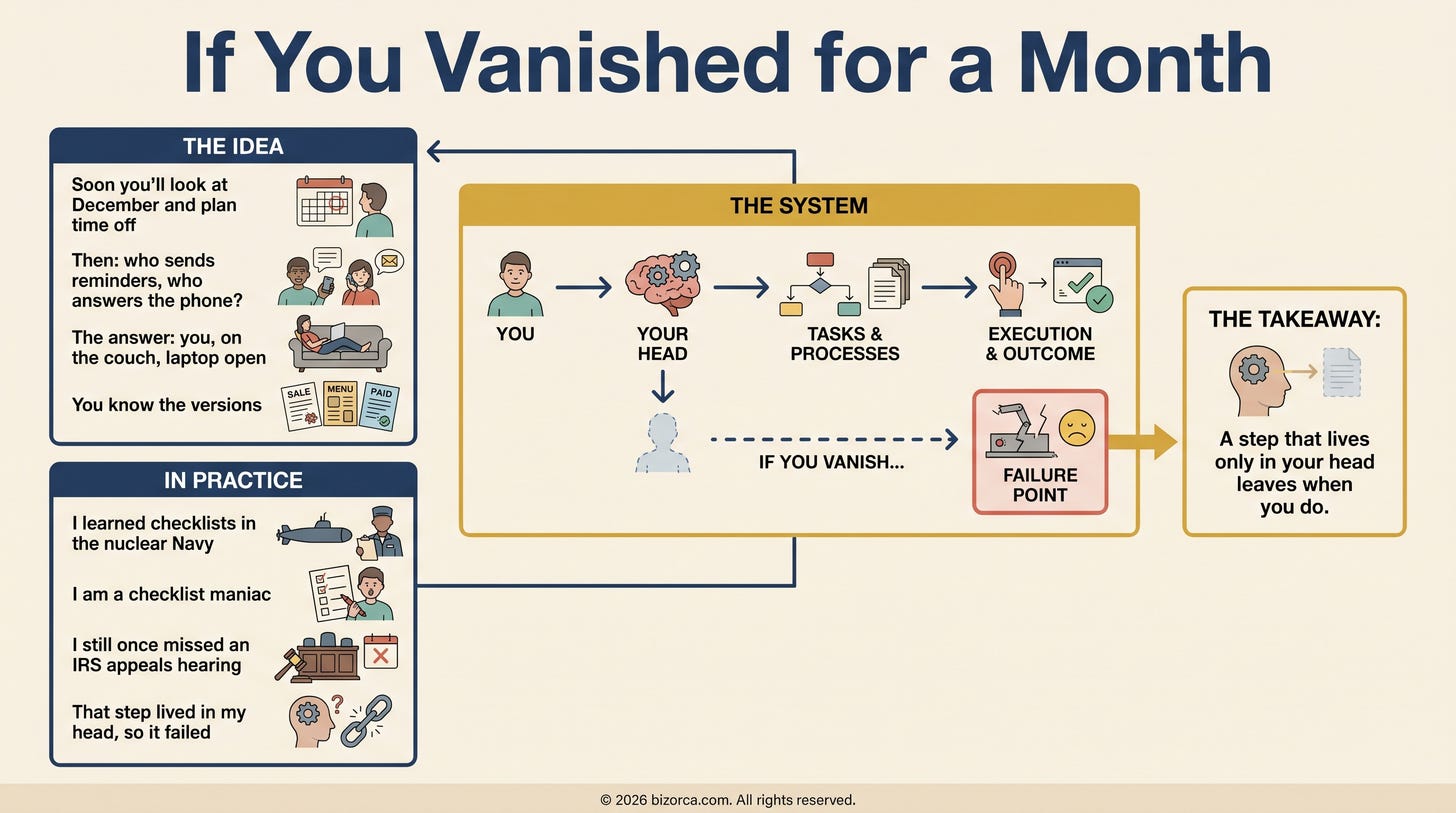
You know the versions. The tax pro who just closed out extension season and is already chasing next year’s documents and engagement letters off a list that lives in one head. The massage therapist confirming every appointment by personal text at ten at night, because clients “like hearing from her.” The counselor whose intake packet is whatever she remembers to attach that morning.
I learned checklists in the nuclear Navy, where nobody turns a valve or flips a switch without reviewing a checklist. I am a checklist maniac. And I still once missed an IRS appeals hearing, because the letter said I was supposed to call them and I didn’t notice. That step lived in my head, so it failed the way things in heads fail: quietly.
That isn’t a practice. It’s a memory with a waiting room.
Start with one number, the head-only count. On a sheet of paper, list every point where a client touches your practice, from first inquiry to the rebook: the inquiry, the booking, the confirmation, the reminder, the intake paperwork, the arrival, the session, the payment, the follow-up, the rebook, and the check-in months later. Dan Kennedy built his client experience by documenting every touchpoint and training every staff member to deliver the same standard; this list is where that starts. Now mark every touchpoint that only you do and that isn’t written down anywhere a stranger could find it. Don’t mark the session. That one is supposed to be you. Count the marks.
- 0 to 2: you’re ahead of most. Hand off one of the remaining ones this month and prove the documentation works.
- 3 to 6: the common range. The practice runs fine as long as nothing happens to you. Pick one this week.
- 7 or more: everything outside the session runs through you. Kennedy calls one “the worst number in business,” and one mission-critical person is the version you’re living. Don’t try to write all seven; that’s how the project dies in a binder. Pick one.
Then answer these, yes or no:
1. Is your intake process written down somewhere besides your head?
2. Could someone else send your new-client welcome, with the right attachments and the right words, without asking you a single question?
3. If you were out sick tomorrow, would someone know which clients to contact and what to say?
4. Have you handed off one recurring task in the last twelve months and actually stopped doing it?
5. Does any written procedure in your practice have a line you added because something went wrong?
6. Could you take two weeks off in the slow season without clients noticing anything except your absence from the session room?
If you said no to three or more of these, you have your project for the month.
The sentence in your head is some version of “they come for me.” Its cousin is “nobody will do it the way I do.” Underneath both sits the belief that the care lives in your personal effort, so anything you hand off gets a little less cared for.
It’s partly true, and that’s why nobody argues with it. Clients do come for you. The counselor’s clients come for the relationship, the massage therapist’s regulars come for her hands, and the tax pro’s clients come because you caught what their last preparer missed. That part of the work is you, and it should stay you.
The trouble is how far the belief stretches. It starts at the session and creeps outward to the reminder text, the intake form, and the follow-up email, and none of those carry your soul. The care in a reminder is whether it arrives the day before, at a sane hour, with the right address in it. That’s a standard, and a standard can be written down. (You at 9 p.m. after a full day of clients don’t hit it every time either.)
You don’t have to stop believing it. The procedure below never asks you to believe anyone could replace you. It asks you to write down one thing that isn’t the session. If the belief runs deeper than one task, that’s the work coaching is for.
I call this the shadow handoff: one task, written while you do it, run by someone else while you watch, then gone from your plate.
1. Pick the one task by rule, not by feel. From your marked list, choose the touchpoint you do every week, that eats the most hours, and that needs the least judgment. Ties go to the one that touches the most clients. Never the session. (For a tax pro in November, that’s usually the year-end document chase. For a massage therapist, confirmations and rebooking. For a counselor, scheduling and the intake packet.)
2. Write it while you do it. The next time you do the task, open a blank document and write each action as one line, in the order it happens. Write the decisions too, the ones you make without thinking: “If the client is new, attach the intake form. If they’re returning, skip it.” Write it for someone who has never met you.
3. Write the words. Every message the task sends gets a script. The confirmation:
“Hi [first name], this is [name] from [practice]. You’re confirmed for [day] at [time] at [address or link]. Please [arrive ten minutes early / have your paperwork in by (date)]. If you need to reschedule, reply here by [deadline] and we’ll find you a new time. See you [day].”
The line for when a client asks to deal with you instead:
“[Name] handles scheduling and paperwork for the practice, so she’s the fastest way to get this sorted. Anything about your session itself comes straight to me.”
The notice to clients:
“Starting [date], [name] will send your reminders and handle scheduling. Same practice, same standards. Your sessions stay with me.”
4. Have someone run it while you watch. A part-time assistant, a virtual assistant, or the person at the front desk of your shared suite runs the checklist on the next three real instances. I picked this up i Europe, where hiring often means a paid trial doing the actual work: the job interview is the job. Every time they stop to ask you something, the checklist has a hole. Write the answer in.
5. Define done in one line, and how you’ll check it. “Every client confirmed by 5 p.m. the day before.” Week one, you review each message before it goes out. Week two, you review after. After that, you spot-check once a week.
6. Fix the checklist, not the person. Every miss becomes a new line. That’s what I did after the appeals hearing: I added “who calls whom” to my appeals checklist and never missed another one.
7. Take your hands off. Turn off your notifications for that task. When you see a message worded slightly differently than you’d have worded it, your hand will reach, and the sentence will be “they’ll notice it isn’t me.” Your answer: “they’ll notice it arrived on time.”
8. Commit to the date. The handoff happens before December 15, ahead of the busy season for tax pros and the holiday weeks for everyone else. Say out loud, ten times: “Starting [date], [name] runs [task].” Tell one person who will ask you about it, and put a 30-day review on the calendar, where you pick the next task.
One task, one checklist, three scripts, one person, and one date.
You’ll want to write the whole practice down at once. Don’t. Write it down the next time you do it. Write it down the next time you do it. Write it down THE NEXT TIME YOU DO IT, which for most of you is tomorrow morning!
The download is the shadow handoff as a checklist, with spaces for your head-only count, the task, the person, and the date.
If you want to talk through which task should go first, bring it to Behind the Books, the free monthly Zoom for practitioners and business owners, at financialhypnosis.com/biz.