

The first time I went to a local dentist, I learned a lot about onboarding—by experiencing a masterclass in how not to do it.
It took four or five phone calls just to reach someone to schedule an appointment. When I arrived, no one was at the front desk, and I stood there for nearly twenty minutes before anyone acknowledged me. Then came a stack of paperwork—page after page of redundant forms—followed by another long wait. I had scheduled both a cleaning and an exam, but the dentist wasn’t actually available, so I only received the cleaning.
Nothing catastrophic happened. No single moment was unforgivable. But the entire experience felt disorganized, indifferent, and stressful. I’ll never go back.
That’s the quiet power of an onboarding experience. Before any real work begins, the system has already told you whether you’re in good hands. In the case of this dental office, I did NOT feel in good hands, and I chose not to continue being a patient.
The reality is that most client relationships don’t break down in the middle of the engagement. The problems inevitably start at the beginning.
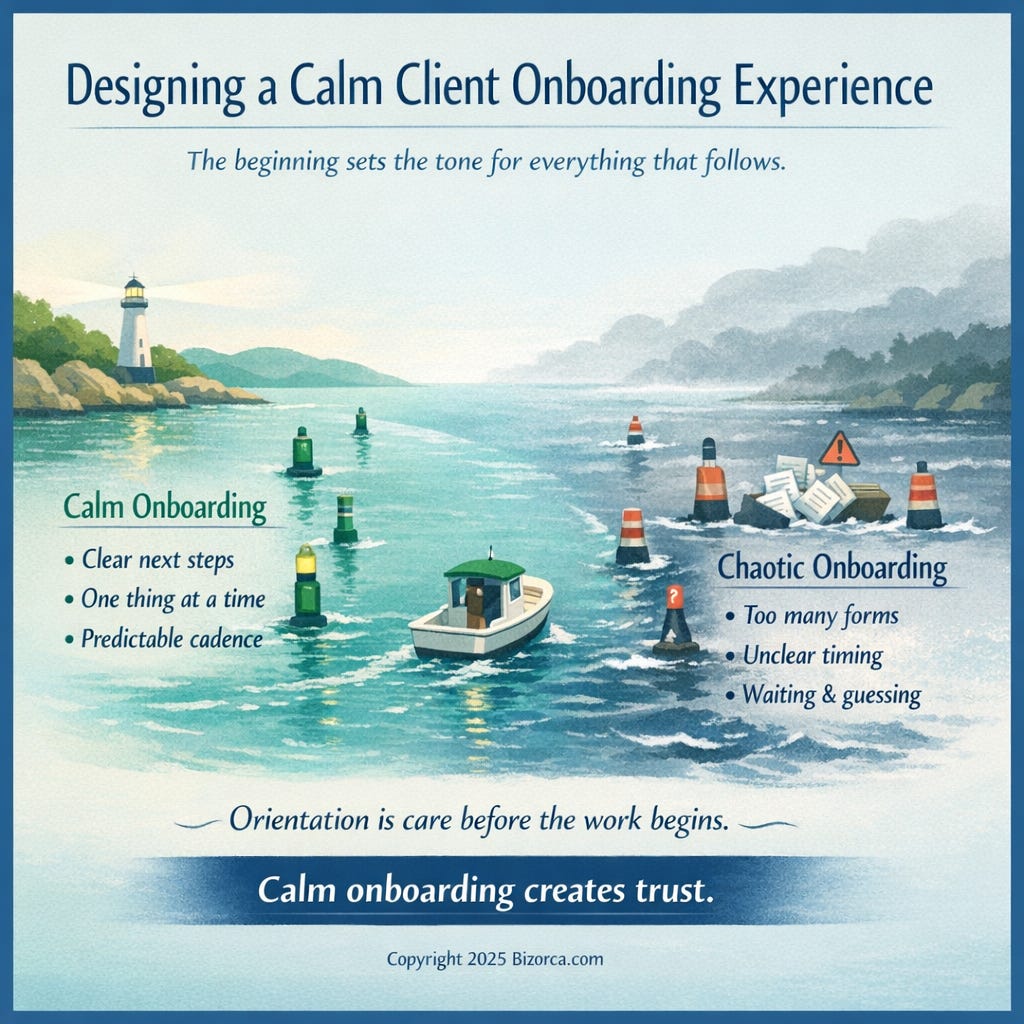
Many practitioners think of their client onboarding as just an administrative burden. It’s not just a boring necessity, though, it’s the place that creates tangible and emotional alignment between you and the client.
A chaotic onboarding process leaves clients guessing, reaching out for clarification, and bracing themselves for confusion.
Clear onboarding immediately let’s the client know what happens next, when, how, and with who. The onboarding steps, even if the needs of the business are simple, are choreagraphed one step at a time, instead of throwing everything at the client at once. Onboarding clearly articulates when sessions occur, sets communication expectations, and bluntly defines what consistency looks like for this business relationship. Reassurances and check-in points are also provided along the way.
11 Traits of a Calm Client Onboarding Experience
Clear: The client clearly understands what happens next.
Sequential: Information and actions are presented in a logical order.
Predictable: Timing and expectations are stated upfront in plain language.
Minimal: Only the bare minimum information necessary to provide services is collected.
Consistent: The onboarding experience matches what was promised in lead generation marketing.
Reassuring: The client feels heard, understood, and guided.
Boundaried: The scope of services, participation expectations, communication norms, and other policies are clear and explicit.
Efficient: The process is streamlined as much as possible, without feeling rushed.
Repeatable: The onboarding process happens the same way, every time.
Calm: The entire process reduces both client and practitioner anxiety instead of adding friction.
Human-aware: The process accounts for attention, empathy, and compassion, not just information collection and starting the work.
Have you experienced a particularly good or exceptionally bad client onboarding experience? Tell us about it in the comments!