

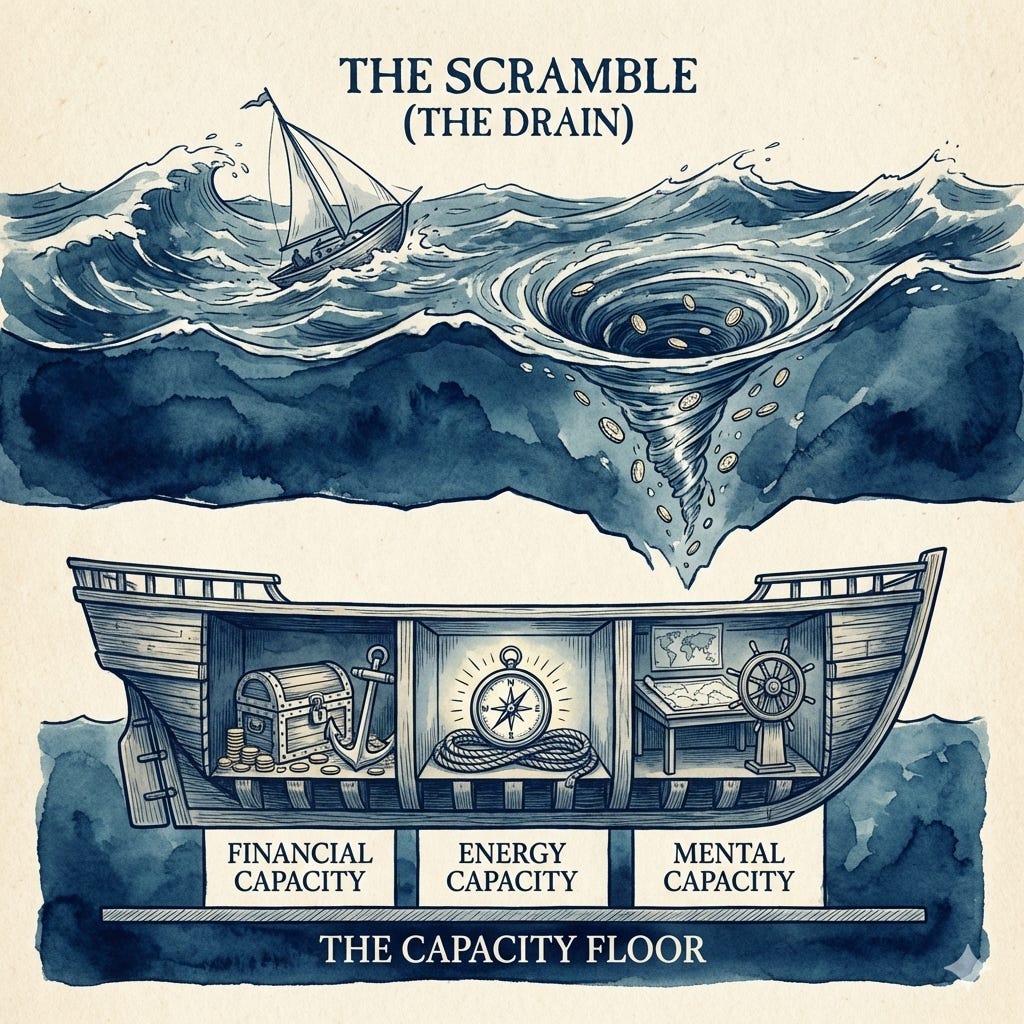
Most business advice focuses on the ceiling: How high can you scale? How much revenue can you capture? How big can your empire get?
But in a solo practice, the ceiling doesn’t kill you. The floor does. Or rather, the lack of one.
If you feel constantly anxious, reactive, or like you are one bad client email away from spiraling, you don’t have a revenue problem. You have a stability problem. You are operating without a Capacity Floor.
Context
In the Bizorca philosophy, we prioritize energy over time. Your energy is your most finite asset.
When a solo practitioner is in “The Scramble”—that frantic state of chasing payments, answering texts at 9 PM, and reinventing the wheel for every new project—they are leaking capacity. Their nervous system is stuck in sympathetic activation (fight, flight, freeze, fawn).
Biologically, you cannot think strategically when you are in fight or flight mode. You can only react. You become a technician of your own misery, putting out fires that you started yourself because you didn’t have a floor to stand on.
Contrast
The “Revenue First” Approach:
Goal: Maximize income immediately.
Method: Say “yes” to everything. Squeeze calls into lunch breaks. Invoice whenever you remember.
Result: High revenue variance, high cortisol, emotional burnout. You are rich in cash (sometimes) but bankrupt in energy.
The “Capacity First” Approach:
Goal: Protect the owner’s ability to perform.
Method: Establish non-negotiable minimums for money, time, and administration.
Result: Predictable cash flow, calm energy, and the mental space to actually enjoy the work you do.
Clarify
So, what is a Capacity Floor?
It is the minimum set of operational and financial standards required to keep your business functioning without your constant, high-intensity intervention. It is the solid ground that prevents you from falling into the basement of burnout.
A strong Capacity Floor has three planks:
1. Financial Capacity (The “Sleep at Night” Number) This is not your goal revenue. This is your survival revenue plus a safety margin, such as 10%. It is the amount of money you need to cover your business overhead, your personal mortgage/rent, and your grocery bill.
The System: You must have a “Buffer Account” with exactly one month of this floor saved. If that account dips, you stop “building” and start “selling” until it’s full.
2. Energy Capacity (The “No-Touch” Zone) These are the boundaries that protect your focus.
The System: No client communication outside of your designated portal or email. No meetings on Mondays (your deep work/admin day). A strict “lights out” time for your business email.
3. Mental Capacity (The “Clear Deck” Policy) The boring stuff that prevents cognitive drag.
The System: A recurring calendar appointment on Friday at 2:00 PM called “The Weekly Close.” You check bank balances, send invoices, and clear your physical desk. You never enter the weekend with a messy ledger. You put all the business stuff that’s bouncing around your brain on to paper or into an app, to “close the tab” in your brain.
The First Plank
We are going to lay the first plank today.
Your Action Step: Identify your Financial Capacity Floor.
Add up your fixed business expenses (software, insurance, licenses, rent, etc).
Add up your minimum viable personal draw (mortgage/rent, food, utilities—no luxuries).
Add 10% for error.
Write this number on a sticky note and put it on your monitor. Write it on your mirror. Write it on your whiteboard. Tape it to the fridge. This is not your target. This is your floor. As long as you are above this number, you are safe. This is the number you manage to first. Here, you can breathe.
Capacity before complexity. Always.
If you’re ready to further explore the concept of regulation before revenue, check out the Bizorca Business Clarity Framework course inside the Bizorca Pod community.