

A local therapist I met with for a financial clarity session shared a familiar pattern. Her calendar felt full, her weeks were busy, yet income and energy were inconsistent. Part of our conversation revealed a quiet truth: A small handful of long-term clients accounted for most of her revenue and referrals. The rest were fairly short engagements, scheduled sessions irregularly, and were higher effort.
That’s the classic Pareto Principle, or 80/20 rule, at work.
In most service businesses, if you conduct an analysis that spans a reasonable length of time such as a year or longer, you’ll discover that roughly 20% of your clients generate about 80% of results. This isn’t just revenue, but also calm, continuity, and just good feelings about working together.
Signals of Solid Retention
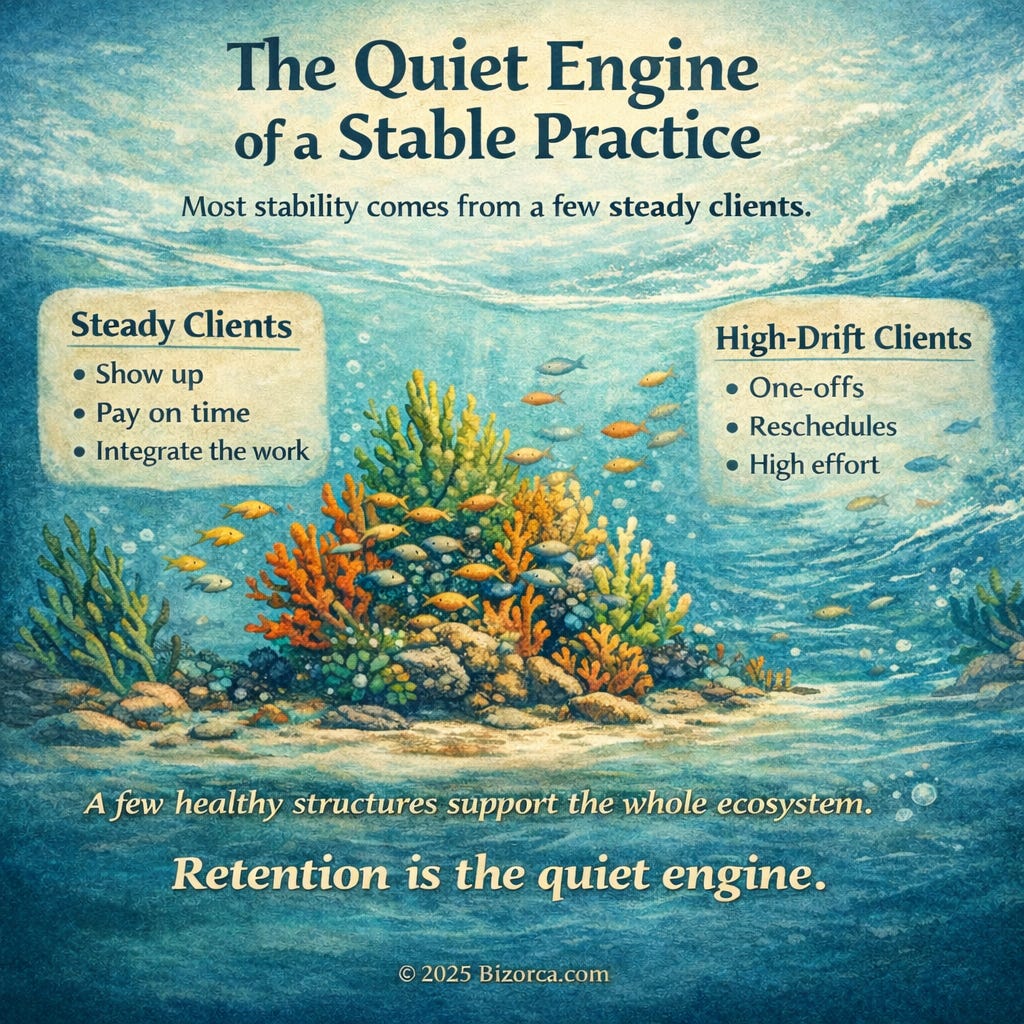
The steady clients: These clients show up on time, respect boundaries, integrate the work, and pay you in full and on time. These are the anchors of your practice.
The high-drift clients: One-off sessions, frequent rescheduling, expressing price sensitivity, or unclear in their commitment to your process. Yes, they create motion, but don’t maintain momentum.
The missed opportunity: Many practitioners spend a lot of their energy chasing down the high-drift clients, or working to attract new clients to fill the void, instead of being able to focus on the best fit clients.
Think of your practice like a reef. A few healthy, living structures are what support an entire ecosystem. Ignore them, and everything weakens.
Client retention isn’t an afterthought in your business. It’s the quiet engine that makes your entire practice stable on rough seas.
Creating Consistency
Here are some practical ways to to filter for steady, recurring clients and build a practice that supports consistency and lower stress for you. I realize that each of these tips could be an entire post unto itself, but at least use these as prompts to consider how you could start using them in your practice.
Name the cadence upfront: Clearly state session frequency expectations before and during client intake. Name the journey, and offer bundled packages of sessions.
Use commitment-based language: Instead of “book anytime”, talk about “ongoing work” and “continuing care”. Words have power, and using appropriate language will shape who opts in to your care.
Default to recurring scheduling: Yes, this induces up-front friction. But on the other side, recurring appointments reduce friction and eliminates your anxiety around having to upsell.
Require payment before services are rendered: Prepayment in full, collecting insurance information, or setting up autopay filters out the tire-kickers and reduces collection follow-up. When I ran my tax firm and started charging even a modest deposit for what was previously a free consultation, the quality of new client conversations changed dramatically for the better.
Clarify scope from the beginning: Explicitly outline your process. State what you do and do not offer. Boundaries eliminate scope creep.
Ask one readiness question during intake: For example, “What would consistent engagement look like for you over the next three months of working together?” The answer to this kind of question reveals readiness to do the work.
Price for ideal clients: Low prices and deep discounting can attract volume, but rarely ideal clients. Set your pricing structure such that it supports your needs, and expresses the value of the transformation you deliver from working with you,
Design a calm first experience: Smooth onboarding makes a massive difference in the client experience, signals professionalism, and sets expectations for how the working relationship will flow.
Quietly reward consistency: Give your best clients priority scheduling, exclusive scheduling windows, and establish “loyalty rewards” to reinforce the behavior without resorting to discounting.
Track who drains vs sustains: On a periodic basis, such as quarterly, review your client roster. Make note of who shows up late or reschedules often, who pays on time and who doesn’t, who saps your energy. Build your book of clients around these individuals, and choose to let go clients that are not working within your parameters. Yes, I highly encourage this periodic review largely for the sake of firing certain clients, so that you create space for new, ideal clients to enter your sphere.
Marketing for stability, not urgency: This is easier said than done, especially for some professions where working with people in crisis is the norm, but in your lead generation marketing and lead follow up marketing communications, message for consistency and calm when possible. Set up your marketing channels to, when possible, attract leads that will become consistent clients, not one-off fixes. If the nature of your work is inherently crisis-driven, then instead build into your process a standard of long-term, ongoing care after the crisis is resolved.
How you structure your operations and marketing makes a massive difference in the clientele you attract and retain. Building a business that serves you and best serves your ideal clients comes down to the systems you put in place. Steady systems create steady clients.
If you want to design systems that support your best clients and let go of constant churn, you’re invited to join the Bizorca Pod community. Build stability together with peers, at a human pace, in a heartfelt, supportive environment.